 Trustwallet
 staking versus Stablecoin Earn
Staking through Trust Wallet uses supported crypto assets to help secure blockchain networks in return for variable rewards. Stablecoin Earn connects eligible users to third-party DeFi vaults for variable yields. It is unavailable in the United States, United Kingdom, and other restricted regions.
- Staking assets
- Supported in-wallet options include ETH, SOL, BNB, TRX, DOT, ADA, and ATOM on their respective networks.
- Interfaces
- Mobile app and browser extension, with staking available for supported assets.
- Control of signing keys
- Private keys stay on your device, while staking positions remain subject to the underlying protocol’s rules.
What staking contributes to a blockchain
Network staking commits supported assets to a blockchain’s staking mechanism, contributing to network operation and security. Validators verify transactions and create blocks, receiving staking rewards for their work on the network.
Trust Wallet provides the interface for interacting with these protocols; it does not control the underlying services. Keeping your signing keys does not remove the protocol conditions that apply to a staking position.
How stablecoin Earn differs
Stablecoin Earn offers vaults powered by third-party DeFi protocols such as Morpho and Aave. Its supported stablecoins include USDT, USDC, DAI, and USDA, with networks including Ethereum, BNB Smart Chain, Arbitrum, and Base. The selected vault must support the stablecoin and network concerned.
Yield depends on market demand and protocol performance, with risks including smart contract vulnerabilities and stablecoin de-pegging. These vault yields arise from DeFi activity, while native staking rewards compensate participation in securing a blockchain.
The service excludes users in restricted regions, including the United States and United Kingdom. Stablecoin Earn has no fixed lock-up period, and each underlying third-party service’s terms still apply. That feature does not establish withdrawal conditions for a separate staking position.
What to compare before committing assets
Consider the asset you would commit, any stated costs, and the rules for withdrawing alongside the displayed rate. An APR-based earnings estimate depends on its inputs and does not guarantee a future reward amount. Staking also leaves the position exposed to changes in the asset’s market price.
A higher SOL balance with a lower dollar value
More staking rewards can increase a SOL balance while a falling SOL price reduces its dollar value.
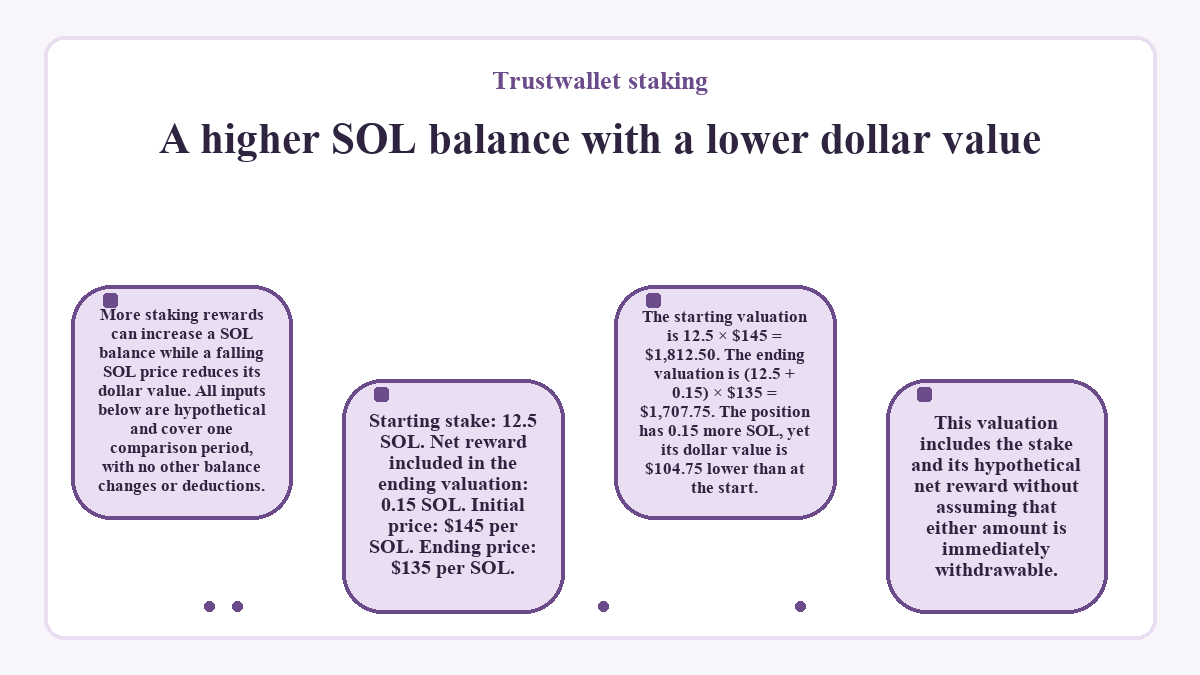
All inputs below are hypothetical and cover one comparison period, with no other balance changes or deductions.
- Starting stake: 12.5 SOL.
- Net reward included in the ending valuation: 0.15 SOL.
- Initial price: $145 per SOL.
- Ending price: $135 per SOL.
The starting valuation is 12.5 × $145 = $1,812.50. The ending valuation is (12.5 + 0.15) × $135 = $1,707.75.
The position has 0.15 more SOL, yet its dollar value is $104.75 lower than at the start. This valuation includes the stake and its hypothetical net reward without assuming that either amount is immediately withdrawable.